


History of the Coptic Studies Institute
The Importance and Necessity of Establishing the Institute
The Coptic Studies Institute was established as an academic, scientific, and educational institution to complement and expand the scholarly mission initiated by national organizations dedicated to Coptic heritage in Egypt, as well as international universities engaged in the study of Coptic civilization abroad. Its establishment provided a comprehensive platform for previously fragmented fields of Coptic Studies, including language, literature, history, archaeology, theology, art, music, architecture, and social sciences, alongside culture, civilization, thought, and philosophy, bringing them together within a comprehensive academic framework.
The Institute’s primary objective is to educate and prepare a new generation of researchers who serve as the cornerstone of efforts to revive and preserve Egypt’s Coptic heritage.
Founders
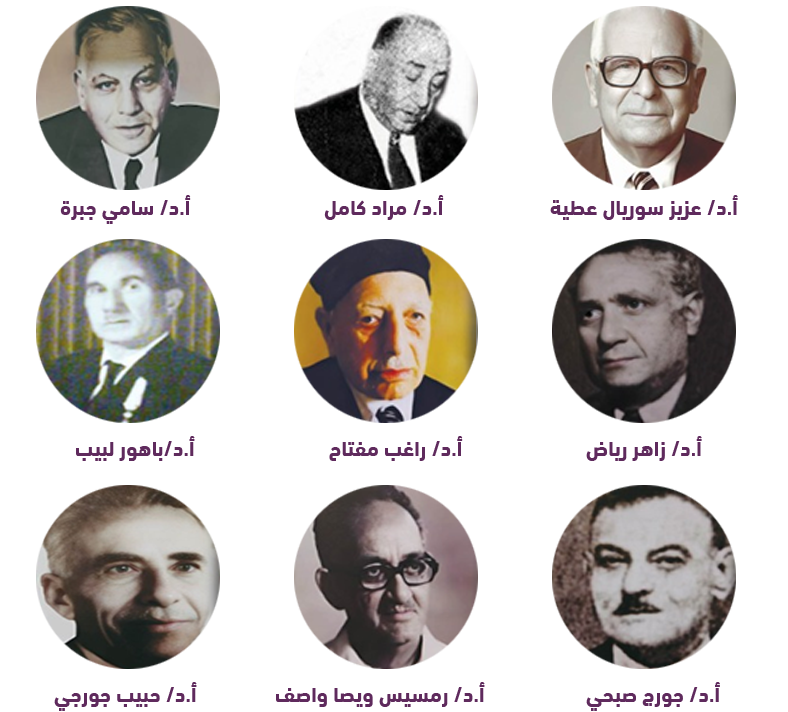
The Coptic Studies Institute was established by a distinguished group of prominent scholars whose pioneering contributions laid the foundations of modern Coptic Studies:
- Aziz Suryal Atiya (1898–1988): A renowned historian with distinguished expertise in medieval history and, later, editor of The Coptic Encyclopedia.
- Murad Kamil (1907–1975): Made significant contributions to the study of ancient Semitic languages.
- Sami Gabra (1892–1979): A distinguished archaeologist known for his outstanding achievements in excavation and fieldwork in Egyptian archaeology.
- Zaher Riad (1908–1980): One of the leading scholars in African Studies.
- Ragheb Moftah (1898–2001): A prominent pioneer in the preservation and documentation of Coptic musical heritage.
- Beyour Labib (1905–1994): A distinguished scholar renowned for his research and pioneering work in Egyptian and Coptic archaeology.
- George Sobhy (1884–1964): A physician and expert in Ancient Egyptian and Coptic languages.
- Ramses Wissa Wassef (1911–1974): A pioneer in the fields of Coptic architecture and art.
- Habib Gorgy (1892–1964): A prominent figure in the development of modern Egyptian and Coptic art.
History of the Establishment of the Coptic Studies Institute
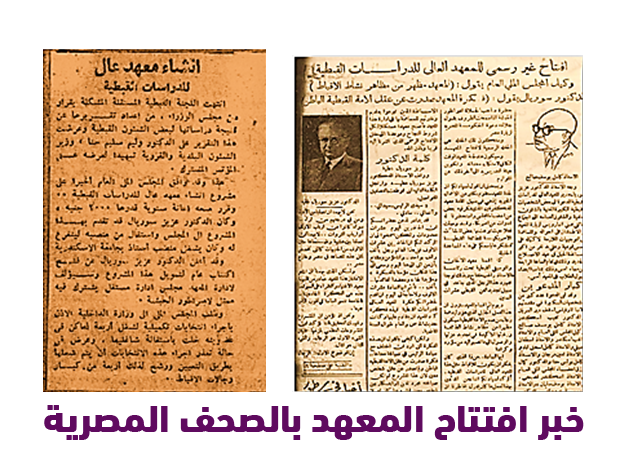
The founders documented the mission and objectives of the Coptic Studies Institute in nine detailed areas, outlined by Professor Dr. Aziz Suryal Atiya in a memorandum concerning the establishment of the Higher Institute of Coptic Studies. The memorandum was sent to Mr. Kamel Youssef Saleh, Vice President of the General Communal Council, in Cairo in October 1953. The Institute was established in Cairo in October 1953, and these founding objectives included the following:
- Preserving and promoting Egypt’s intellectual heritage during the Christian era.
- Coordinating the efforts of authors and researchers interested in Coptic Studies and guiding their work in a sound academic direction.
- Encouraging and training monks in scientific research, as they are often selected as leaders of the Church, and given the role of monasteries as centers of cultural enlightenment.
- The Institute aspires to become a distinguished center for receiving Western researchers specializing in Coptic civilization or wishing to study it. It will provide them with academic guidance based on rigorous scientific principles, ensuring the proper conduct of their research and the achievement of valuable academic results.
- The Institute aspires to serve as a center for coordination and partnership with missions and institutions affiliated with leading international academic and cultural organizations.
- Studying and analyzing Coptic antiquities preserved in the Coptic Museum to reveal their artistic and archaeological value.
- Focusing on archaeological excavations and research, particularly at Coptic sites, while cooperating with various relevant authorities with the approval of the national authorities.
- Conducting scientific visits to Coptic monasteries and churches in Egypt and Ethiopia, documenting their features and uncovering new aspects of their history.
- Establishing the Institute as a leading educational institution for postgraduate studies, directing academic publications, and awarding advanced degrees in Coptology.
Beginning in 1955, the Institute’s objectives expanded to include the following:
- Conducting archaeological excavations and restoring Coptic antiquities in churches, monasteries, and museums, while preserving their beauty and authentic heritage.
- Recording and transcribing the rites and hymns of the Church.
- Guiding and developing Coptic art and architecture and improving design practices.
- Organizing public lectures and publishing them in full.
- Sending scientific missions to monasteries to catalogue manuscripts and photograph their contents.
- Promoting social studies in all aspects of Coptic society, guided by national and Coptic principles.